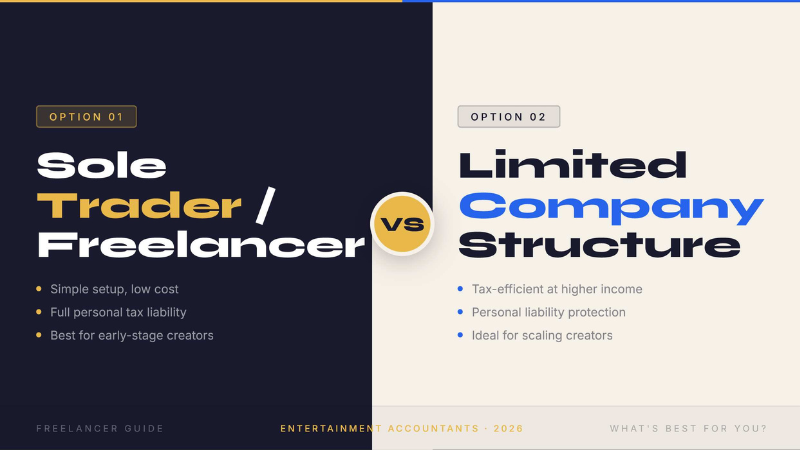
If you’re a creator—whether you’re a designer, influencer, musician, or content producer—one of the biggest financial decisions you’ll make is how to structure your business. In the U.S., this usually comes down to staying a sole proprietor (freelancer) or forming a limited liability company (LLC), with the option to elect S-Corporation (S-Corp) taxation later.
Each option affects how much tax you pay, how you manage risk, and how you grow. Here’s a simple breakdown to help you decide.
What It Means to Be a Freelancer (Sole Proprietor)
A freelancer is the simplest way to operate. You don’t need to register a separate business entity—you and your business are legally the same.
How taxes work:
- You report income and expenses on Schedule C
- You pay income tax + self-employment tax (15.3%)
- You can claim business deductions to reduce taxable income
Pros:
- Easy to start
- Low cost
- Simple tax filing
Cons:
- You’re personally liable for any debts or legal issues
- Higher self-employment taxes as income grows
This setup works well if you’re just starting or earning a moderate income.
What Is an LLC (Limited Liability Company)?
An Limited Liability Company (LLC) is a separate legal entity. It helps protect your personal assets if something goes wrong in your business.
How taxes work:
- By default, a single-member LLC is taxed like a sole proprietor
- You still file Schedule C unless you choose a different tax status
Pros:
- Personal liability protection
- More credibility when working with brands or clients
- Flexible tax options
Cons:
- Setup and annual state fees
- Slightly more admin work
An LLC doesn’t automatically reduce taxes—but it gives you the option to optimize later.
When to Consider an S-Corp Election
Once your income grows (typically $60,000+ profit annually), you may benefit from electing to be taxed as an S Corporation.
How it works:
- You pay yourself a “reasonable salary” (subject to payroll taxes)
- Remaining profit is taken as distributions (not subject to self-employment tax)
Why it matters:
This can reduce how much you pay in self-employment taxes, which is where many creators save money.
Things to keep in mind:
- More paperwork and compliance
- Payroll setup required
- You may need professional help to manage it correctly
Tax Comparison: Freelancer vs LLC vs S-Corp
- Freelancer: Simple, but you pay full self-employment tax on all profits
- LLC (default): Same tax as freelancer, but adds legal protection
- LLC + S-Corp election: Potential tax savings, but more complexity
The biggest tax difference comes when you move from standard self-employment to an S-Corp structure.
Which One Is Best for You?
Freelancer (Sole Proprietor) is best if:
- You’re just starting out
- Your income is still growing
- You want to keep things simple
LLC is best if:
- You want legal protection
- You’re working with bigger clients or contracts
- You want a more professional setup
LLC + S-Corp is best if:
- You’re earning consistent, higher profits
- You want to reduce self-employment taxes
- You’re ready for more structured financial management
Final Thoughts
There’s no one-size-fits-all answer. Many creators start as freelancers, move to an LLC, and later choose S-Corp taxation as their income increases.
The goal isn’t just to save on taxes—it’s to choose a structure that supports your growth while staying compliant with IRS rules. Keeping clean records, separating personal and business finances, and reviewing your setup regularly can make a big difference over time.
If you’re unsure which path makes sense for your current income, getting professional guidance can help you avoid costly mistakes and make the most of your earnings.